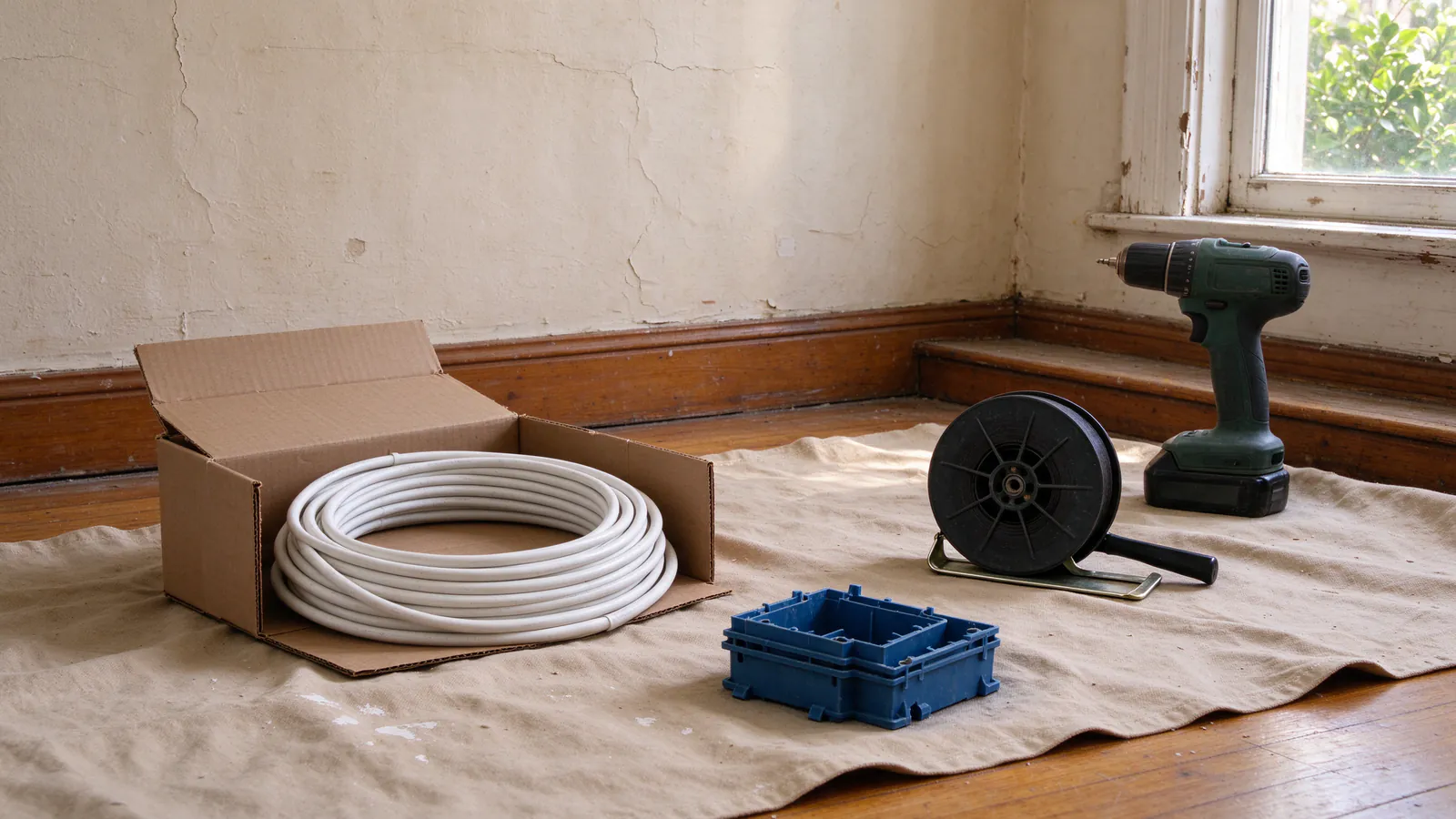
A typical San Francisco range for replacing the knob and tube in a single-family home is $20,000 to $50,000 or more for the electrical scope with permits, before any panel upgrade.
Where a house lands in that range depends less on the wire than on access: how many circuits are still live, whether attic, basement and garage routes reach them, and how much plaster has to be opened and restored. Panel or service work is separate, typically $3,000 to $10,000 in San Francisco, and other contractors’ quotes may or may not include patching. Fog City SF Knob and Tube manages knob and tube replacement in San Francisco and the East Bay, with the electrical work carried out by licensed and insured electrical contractors. It publishes these figures so you can budget before anyone visits, and its quotes include plaster patching as its own line.
Typical ranges
These are budgeting ranges for planning, not quotes or company rates. The San Francisco figures run well above the national ones, and the section on wages below shows part of the reason.
| Work | Range | What it is | What it covers |
|---|---|---|---|
| Whole-house knob and tube replacement | $20,000 to $50,000 or more | A typical San Francisco range | The electrical scope for a single-family home, with permits. Panel or service work is separate; patching and paint may or may not be included |
| Whole-house knob and tube replacement | $12,000 to $35,000 | A national budgeting range | The same scope in a typical house, nationally |
| Electrical work per square foot | $10 to $20 per sq ft of finished floor area | A national budgeting range | Electrical work only, no patching or panel |
| Partial replacement (several remaining circuits) | $2,000 to $10,000 | A national budgeting range | Replacing the circuits still live after earlier work |
| Panel and service upgrade, 100 A to 200 A, overhead | $3,000 to $10,000 | A typical San Francisco range | New panel and overhead service; underground service with trenching can run past $10,000 |
| DBI electrical permit | $305 to $1,289 | Current DBI fees | Permit issuance with its included inspections |
Knob and tube replacement versus whole-house rewiring cost
Knob and tube replacement and a whole-house rewire overlap but are priced differently. Replacing knob and tube means replacing the circuits that still run on it. A whole-house rewire replaces every old branch circuit, including cloth-insulated cable and later ungrounded wiring, and usually adds circuits. In most pre-1940 San Francisco houses the two converge, because the original circuits, the later additions and the splices between them all have to go to leave nothing old live.
The cost to rewire an old house, as opposed to a newer one, comes from the house rather than the wire. Plaster and lath takes longer to open and close than drywall. Tall ceilings, picture rails and original trim slow the work and narrow where openings can go. Old fuse boxes and small services often mean a panel upgrade alongside. And nobody knows exactly how much knob and tube remains until each circuit is tested in a knob and tube inspection, which is why a quote built on that test is narrower than one built on square footage.
What moves the price
| Factor | Why it matters | Effect on the price |
|---|---|---|
| Number of active circuits | Each live circuit is a run to replace and a set of devices to rewire | The single biggest driver of electrical labor |
| House size, layout and stories | More rooms and floors mean longer runs and more vertical routes | Rises with floor area and with each added story |
| Attic, basement and garage access | Open framing lets cable be fished without opening walls | Good access pulls a house toward the low end |
| Plaster and lath vs drywall | Plaster cracks if cut carelessly and takes longer to restore | Plaster walls and ceilings push the price up |
| Finished ceilings and walls | No access from above or below means more openings | More openings, more patching |
| Panel capacity and condition | A full panel or a fuse box may not take the new circuits | Can add a panel or service upgrade |
| New circuits added | Kitchens, baths, laundry and appliances need their own | More circuits, more cable and breakers |
| Number of dwelling units | DBI requires a permit per unit outside R-3 buildings | Multiplies permit fees and inspections |
| Occupied home or tenants | Rooms must be protected and power sequenced | Adds setup and scheduling time |
| Lead-safe requirements | DBI presumes pre-1979 buildings contain lead paint | Adds containment and cleanup to openings |
| Insulation over old wiring | Insulated cavities hide runs and splices | Can slow tracing and removal |
| Historic finishes | Original trim and plaster ornament limit openings | Slower, more careful access |
| Patching and paint scope | Some quotes include it, some do not | Can move a total by thousands of dollars |
The cost estimator gives a first figure for your house without a phone call.
What’s inside a San Francisco knob and tube replacement price
Part of a price can be traced to public figures: wages, code-required materials, permit fees and utility rules. Other parts, such as wall restoration, have no public figure and have to be checked as scope. Electricians in the San Francisco-Oakland-Fremont metro earn a mean $49.85 an hour, about 45% above the $34.37 national mean, according to the Bureau of Labor Statistics in its most recent occupational wage survey; the median is $44.63 against $30.38 nationally. A wage is not a billing rate: the hourly rate a contractor bills also carries insurance, licensing, vehicles, tools, supervision and overhead.
| Part of the price | What sets it | Local figure |
|---|---|---|
| Electrician labor | Hours to trace, route and connect each circuit | Electricians: mean $49.85 an hour in the SF metro vs $34.37 nationally; median $44.63 vs $30.38 (BLS) |
| Plaster restoration labor | Number and size of openings, plaster vs drywall | Plasterers: mean $37.07 an hour in the SF metro vs $29.83 nationally (BLS) |
| Drywall and ceiling repair labor | Where ceilings or walls are drywall | Drywall installers: mean $43.79 an hour in the SF metro vs $30.58 nationally (BLS) |
| Paint after patching | Whether touch-up or full-wall paint is in scope | Painters: mean $33.91 an hour in the SF metro vs $26.64 nationally (BLS) |
| Code-required protection | Arc-fault protection on replaced circuits (CEC 210.12), ground-fault protection in listed locations (CEC 210.8), tamper-resistant receptacles (CEC 406.12) | Material requirement, no public price |
| Grounded cable | Every new circuit carries an equipment grounding conductor | Material requirement, no public price |
| Service-entrance conductors, if the service changes | San Francisco requires a raceway such as rigid metal or PVC conduit, at least 1-1/4 inch | SF Electrical Code amendment 230.43 |
| Electrical permit | Outlets and devices, building size, number of units | $305 to $1,289 per permit; $740 for more than 40 devices (DBI) |
| Extra inspections | Re-inspections beyond those included | $259 per half hour (DBI) |
| Work without a permit | An investigation fee if work is done before a permit | Nine times the permit issuance fee plus the original fee (DBI) |
| Utility side of a service upgrade | PG&E’s installed cost above its allowance | Allowance of $3,255 per dwelling unit for service extensions; PG&E sets the rest case by case |
| Lead-safe practice | Containment, signage, neighbor notice and cleanup for pre-1979 buildings | A scope item, no public price (DBI, EPA) |
| Wall and ceiling restoration | Finish level: closed, textured or painted | No public figure; check it as scope in every quote |
| Tenant relocation, if needed | Rent Board rules when a tenant must leave temporarily | No fixed figure; set by the Rent Ordinance and the length of the stay |
Those wage gaps run in the same direction as the price gap between the San Francisco and national ranges, but they are not a multiplier. Nobody can turn a wage into a project price without knowing the hours, and the hours depend on the house.
DBI permit fees
San Francisco’s Department of Building Inspection sets electrical permit fees by the number of outlets and devices, where appliances count as devices alongside receptacles, switches and light outlets. These are current DBI fees for Category 1 general wiring in residential buildings up to 10,000 square feet; DBI revises its schedule from time to time, so check the current table before budgeting.
| Permit category | Fee | Inspections included |
|---|---|---|
| Up to 10 outlets and devices | $305 | 1 |
| 11 to 20 outlets and devices | $450 | 2 |
| Up to 40 outlets and devices, including a service upgrade up to 200 A | $580 | 3 |
| More than 40 outlets and devices | $740 | 4 |
| Buildings of 5,000 to 10,000 sq ft | $1,289 | 5 |
| Service equipment of 225 A or less (Category 3) | $450 | 2 |
| Re-inspection | $259 per half hour | n/a |
| DBI hourly inspection rate | $519 an hour ($555 off-hours) | n/a |
A whole-house rewire usually lands in the more-than-40-devices category. DBI requires a separate permit for each existing dwelling unit except in R-3 occupancies, so a building of flats multiplies these fees. Exceeding a permit’s scope costs two times the issuance fee, and the pre-cover inspection has to happen before walls close: DBI can order concealed, uninspected work opened at the owner’s expense, which turns into patching cost. The Mission District page works through the per-unit arithmetic for a flat building.
Panel, service and PG&E
A typical San Francisco range for a 100 A to 200 A panel and overhead service upgrade is $3,000 to $10,000. Underground service with trenching can run past that. The panel upgrade is a separate scope from the rewire, and a new panel by itself removes no knob and tube, as the panel upgrade vs rewiring guide explains.
The utility side has its own rules. Under its Rule 15 and Rule 16 tariffs, PG&E gives a residential allowance of $3,255 per dwelling unit toward service extensions, and the applicant pays PG&E’s estimated installed cost above it, plus tax, with full payment due before construction. Whether that allowance offsets the upgrade of an existing service is a question for PG&E on each job. Residential panel changes up to 320 A go through PG&E’s Express Connect process, and homeowners report that the utility steps can take months, so they are best started early.
Incentives and programs
One program in San Francisco pays directly toward knob and tube work, and only as part of a weatherization project. BayREN describes its knob and tube rebates as limited-time offers and has not published an end date, so check the BayREN EASE Home page before planning around them. The BayREN rebate guide covers the steps. Fog City SF Knob and Tube helps with the rebate paperwork, and the electrical contractors who do the work supply the electrician’s invoice and the inactivity certification the program asks for; BayREN decides eligibility and the amount.
| Program | Amount | Who qualifies | Conditions |
|---|---|---|---|
| BayREN EASE Home, knob and tube remediation | Up to $2,000 reimbursed | PG&E customers with household income at or below 120% of area median (in San Francisco, up to $232,050 for a household of four); single-family homes of four or fewer units built before 2010 | Part of an EASE Home project with at least one weatherization measure; a licensed electrician’s invoice and certification of knob and tube inactivity |
| BayREN EASE Home, inactive certification | $300, as announced | Same as above | A licensed electrician’s certification that the knob and tube is inactive (ABAG); the EASE Home page does not show this line, so confirm it with BayREN |
| BayREN EASE Home, weatherization | BayREN covers 80% of essential weatherization upgrades; the co-pay is capped at 20% | Same as above | Work done by BayREN partner contractors |
| CleanPowerSF Electrify Your Home | Bill credits, such as $1,200 for a heat pump water heater or heat pump HVAC | CleanPowerSF residential customers | Covers appliances, not wiring; first come, first served |
| Federal 25C home improvement credit | Ended | No longer available | The IRS allows it only for property placed in service by December 31, 2025 |
City of Alameda households buy power from Alameda Municipal Power rather than PG&E, so they fall outside EASE Home. Homeowners insurance is not an incentive program: when a carrier raises knob and tube, the question is whether it will write or renew the policy, which the knob and tube insurance guide covers.
Illustrative budgets
These examples are illustrative only. They combine the ranges and fees above for common situations; they are not quotes, and a real price comes from testing the house.
| Situation (illustrative) | How the budget is built | Illustrative total |
|---|---|---|
| Single-family house, full replacement, existing panel can carry the new circuits | Whole-house range, permits included | $20,000 to $50,000 or more, plus patching if the quote leaves it out |
| Single-family house, full replacement plus an overhead 100 A to 200 A upgrade | Whole-house range plus the panel range | $23,000 to $60,000 or more, plus patching if not included |
| A few circuits still live after an earlier remodel | Partial national range | $2,000 to $10,000, a national budgeting range; the DBI permit is $305 or $450 if it is not already included |
| Six-unit flat building, each unit over 40 devices | DBI fee of $740 times six units | $4,440 in permit fees alone; the wiring is priced per unit after testing |
| Eligible household insulating the attic, knob and tube found inactive | BayREN certification rebate, if still offered | $300 back toward the electrician’s certification, as announced; confirm with BayREN |
Getting a quote you can compare
A comparable quote names the circuits it replaces, the openings it expects, who patches them and to what finish, whether the panel or service changes, and which permits it includes. The rewiring quote checklist lists the lines to ask for. If you want the background first, the knob and tube wiring guide explains what is being replaced and why, and the replacement process guide shows how the work runs.
To put a number on your own house, call (628) 296-7628 or request an estimate with the age of the house, the number of units and what prompted the question.