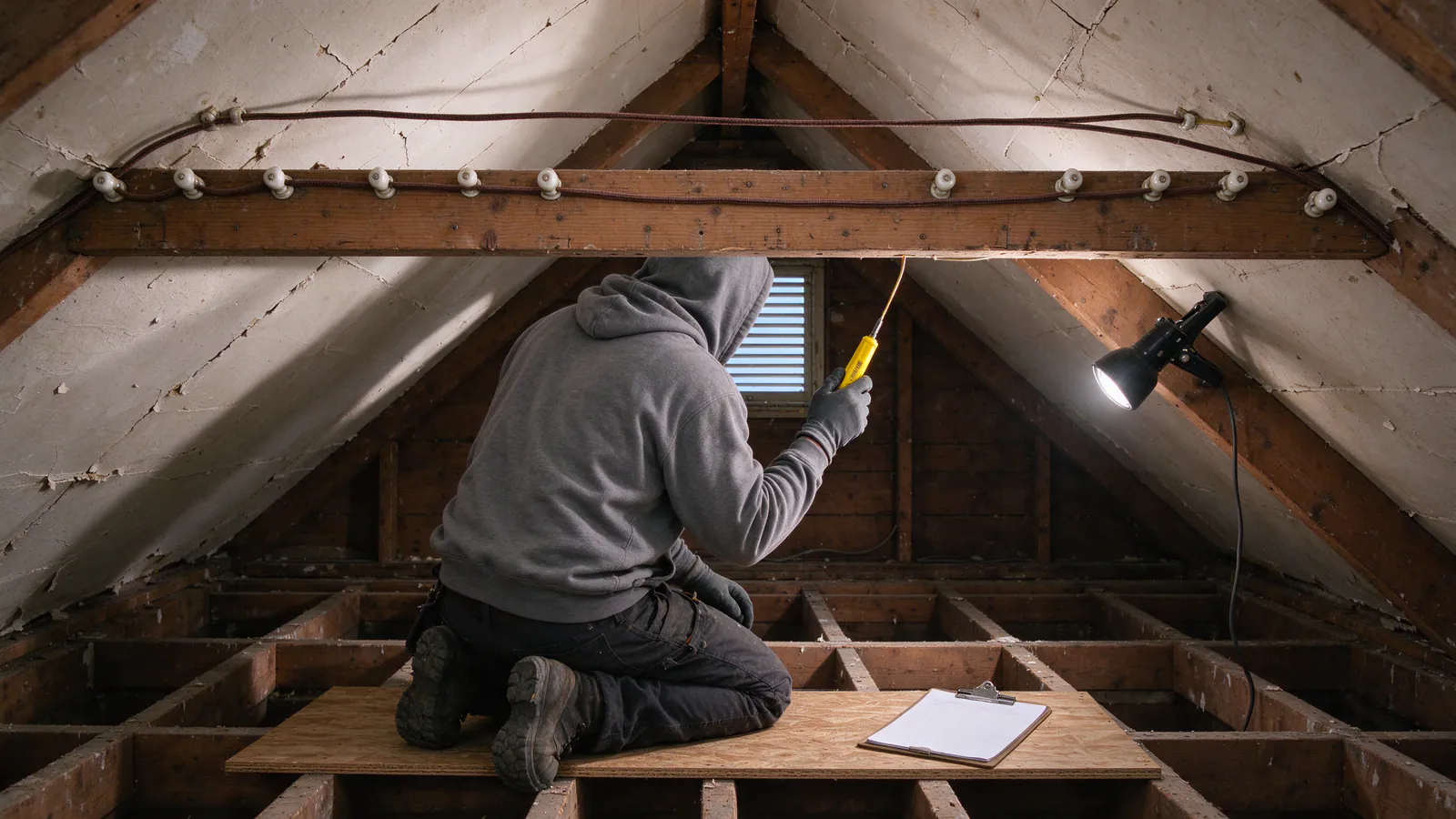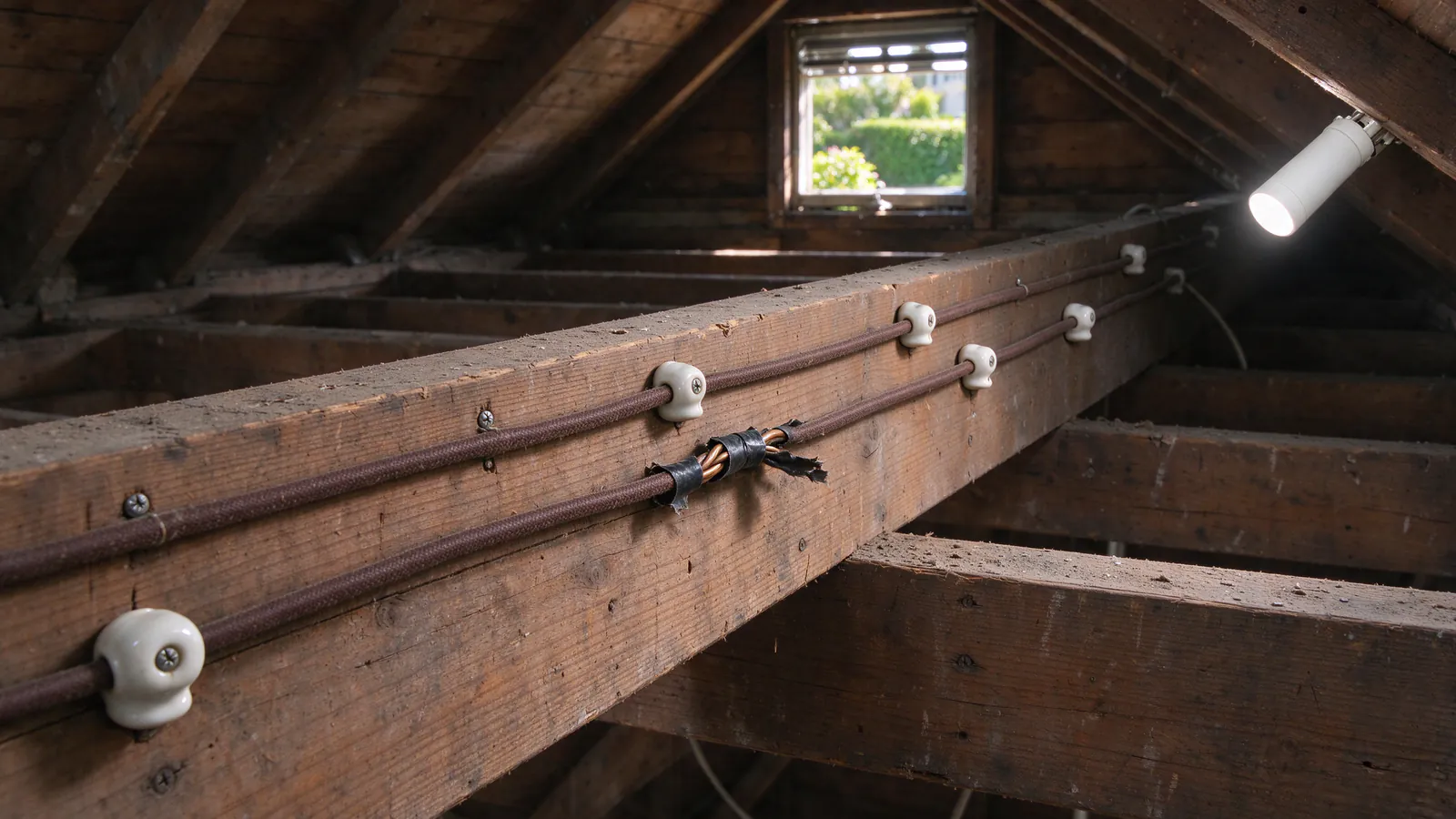
Knob and tube wiring is not dangerous just because it is old. Undisturbed runs in open, dry framing can still be in serviceable condition. It becomes dangerous through what has happened to it since: cracked insulation, loose or improper splices, fuses larger than the wire can carry, insulation packed around it and loads it was never designed for. Only testing shows which of those applies.
Fog City SF Knob and Tube manages knob and tube inspection and replacement in San Francisco and the East Bay, and the testing and electrical work are carried out by licensed and insured California C-10 electrical contractors. This guide explains how each failure works, so an inspection finding or an insurer’s question can be read for what it actually says. When you want your own house checked, a knob and tube inspection tests every circuit at the walk-through.
What the fire record shows
San Francisco Fire Department investigators told ABC7 News that the department “has not seen trends in knob and tube electrical wiring residential structure fires.” That is the only statement on the subject from a San Francisco fire agency. No SFFD data release breaks out residential fires by wiring type, so there is no reliable local figure for how many house fires knob and tube causes, and any number you read online for San Francisco is an estimate from somewhere else.
The absence of a trend cuts both ways. It means the city is not seeing knob and tube houses burn at a rate that stands out, which matches the design’s real strengths. It does not mean any particular house is safe, because the hazards below are specific to how one house has been altered and used. It also does not settle the insurance question: carriers decide on their own underwriting rules, not on fire department trends, as the California insurance guide explains.
Why age alone is the wrong measure
The original installation was sound for its time. The hot and neutral ran several inches apart, so a short between them needed both wires to fail at the same spot. Each wire sat on porcelain in open air, so it shed heat easily. Porcelain does not burn, decay or conduct. The knob and tube wiring guide covers how that design works in detail.
Homeowners report a fair question: if the wiring has been fine for decades, why would it be a problem now? The answer is that the risk does not grow evenly with age. It builds through specific changes, each of which undoes one of the design’s protections. Spacing protects against shorts until a later splice brings conductors together in a wall. Open air keeps wires cool until insulation surrounds them. The fuse protects the wire until someone installs a bigger one. That is why two houses of the same age can carry very different risk.
Damaged insulation exposes the conductor
The rubber insulation under each wire’s cloth covering hardens and cracks with age, heat and handling. Cracks tend to open where the wire bends around a knob, enters a tube or was moved during later work, and rodents chew it in attics and basements. Once the rubber falls away, bare copper is exposed.
In open air, with the other conductor inches away, exposed copper can sit for years without incident. The danger is in what it can touch: a nail, a pipe, a heating duct, damp framing, debris or nesting material, or another wire brought close by a later alteration. Contact can leak current or arc. This is also why nobody should handle suspect wiring to look at it: the insulation that is still intact often cracks the moment the wire is moved, and an electrician assessing old runs works without disturbing them where possible.
Loose connections and improper splices
Original splices were twisted, soldered and wrapped in the open framing. Many still hold. The larger concern is the connections added later: new cable tied into an old run with no box, a joint buried in a wall or ceiling, wires of different sizes joined on one circuit, or tape that has dried and fallen off.
A loose or poor connection has resistance, and current through resistance makes heat at that single point. The heat oxidizes the metal, which raises the resistance, which makes more heat. Over time that cycle can loosen the joint until current jumps the gap as an arc, which is hot enough to char wood and insulation nearby. Because these joints are usually hidden, a warm cover plate, a faint smell or a flicker may be the only outward sign. Mixed-era wiring, where old and new were joined by many hands, often carries more risk than the original layout; the knob and tube mixed with Romex guide covers where those joints hide.
Unsafe modifications
A century of owners leaves its mark. The modifications that matter most for safety:
- Overfusing. A circuit that kept blowing its fuse often got a larger one. That stops the nuisance and removes the protection, because the fuse now lets through more current than the old conductor can carry. A panel replacement can carry the same mistake forward if old circuits land on oversized breakers.
- Tapped circuits. New outlets, fixtures or appliances spliced onto old runs add load and joints. In Alameda, the Building Official states that knob and tube “cannot be extended,” and homeowners report electricians elsewhere declining to add to it.
- Three-prong outlets with no ground. A grounding-type outlet fitted to a two-wire circuit, sometimes with the ground terminal jumpered to neutral, looks modern and is not. The three-prong outlet guide explains why that can be worse than a plain two-prong outlet.
- Extension cords as wiring. Cords stapled along baseboards or run through walls to make up for a lack of outlets.
Overloaded circuits run hot
Original circuits were laid out for ceiling lights and a few outlets, often several rooms to one fuse. A space heater, microwave, hair dryer or window air conditioner on that circuit can push current close to, or past, what the old conductor was meant to carry for hours at a time. Current heats a conductor in proportion to load; open air carries that heat away, and anything that traps it raises the temperature of the rubber around the copper, which speeds its aging.
Correctly sized fuses limit how far an overload can go. Overfusing removes that limit, which is why the two problems so often appear together. The knob and tube amp rating guide goes into what an old circuit can reasonably carry.
Insulation packed around the wiring
Knob and tube depends on air. Blown-in or batt insulation around the conductors traps their heat and hides their condition. The California Electrical Code bars concealed knob and tube in insulated hollow spaces where the insulation envelops the conductors, unless a California-licensed electrical contractor surveys the wiring, certifies it is in good condition and files that certification. BayREN’s announcement of its knob and tube rebate put the risk plainly: adding high-wattage appliances or insulation over it “can lead to serious fire risks.” The attic insulation service covers the survey or the rewiring that clears an attic for insulation.
Ungrounded circuits and shock
Knob and tube has no equipment grounding conductor. If a hot wire touches the metal case of a plugged-in appliance, there is no ground path to carry that fault back to the panel and open the fuse quickly, so the case can stay energized until someone touches it. Two-prong appliances are built for that; metal-cased appliances on cheater adapters are not. The three-prong outlet guide covers the code-approved fixes.
Reading the warning signs
Symptoms rarely prove one cause, so read them by combination rather than alone.
Switch the circuit off at the panel now
- A cover plate, outlet or switch that is warm to the touch, or discolored around the slots
- A burning, hot-plastic or fishy smell near a device, fixture or the panel
- Lights that dim or flicker together with warmth, buzzing or a smell
- A tingle from an appliance, faucet or fixture
- Fuses that blow again right after replacement, or a fuse clearly larger than its neighbors
Book a test, not an emergency
- Flicker on one lamp with no heat or smell
- Two-prong outlets and no other symptoms
- Knob and tube visible in the attic or basement, undisturbed and clear of insulation
- An inspection report or insurer letter with a deadline that leaves time to test first
What testing shows that looking cannot
Most of the hazards above are invisible from a room. An assessment finds them by working from the panel outward: each circuit is identified at the fuse box or panel and traced to what it serves, live knob and tube is separated from abandoned runs, fuse and breaker sizes are compared with the wire they protect, and accessible attic, basement and garage framing is examined for insulation contact, damage, splices and later connections. An electrician may use a circuit tracer, a multimeter, an inspection camera and, where appropriate, an insulation resistance tester. The result is a written circuit record that says what is live, what is not, and which conclusions rest on testing rather than on what was visible.
That last point matters, because no assessment can see inside every closed wall. The active vs abandoned guide explains why the live or dead question comes first, and the risk assessment tool helps sort what you already know before a visit.
Is any of it still live in your walls?
Each circuit is tested at the walk-through, and the findings come back in writing with what each one means for the house.
From finding to scope
A test usually lands a house in one of a few places. A single damaged splice on a mostly retired system may justify a targeted repair, which the repair or replace guide weighs. A handful of live circuits left after a remodel points to a partial replacement. A house that is still mostly original, or mixed, usually ends at whole-house rewiring. Until then, keep heaters and kitchen appliances off old circuits, never fit a larger fuse, and do not let anyone tap or insulate over the old runs. The signs your house needs rewiring guide pulls those decision points together.
If you have noticed one of these signs, call (628) 296-7628 or request an estimate with the age of the house and what prompted the question.