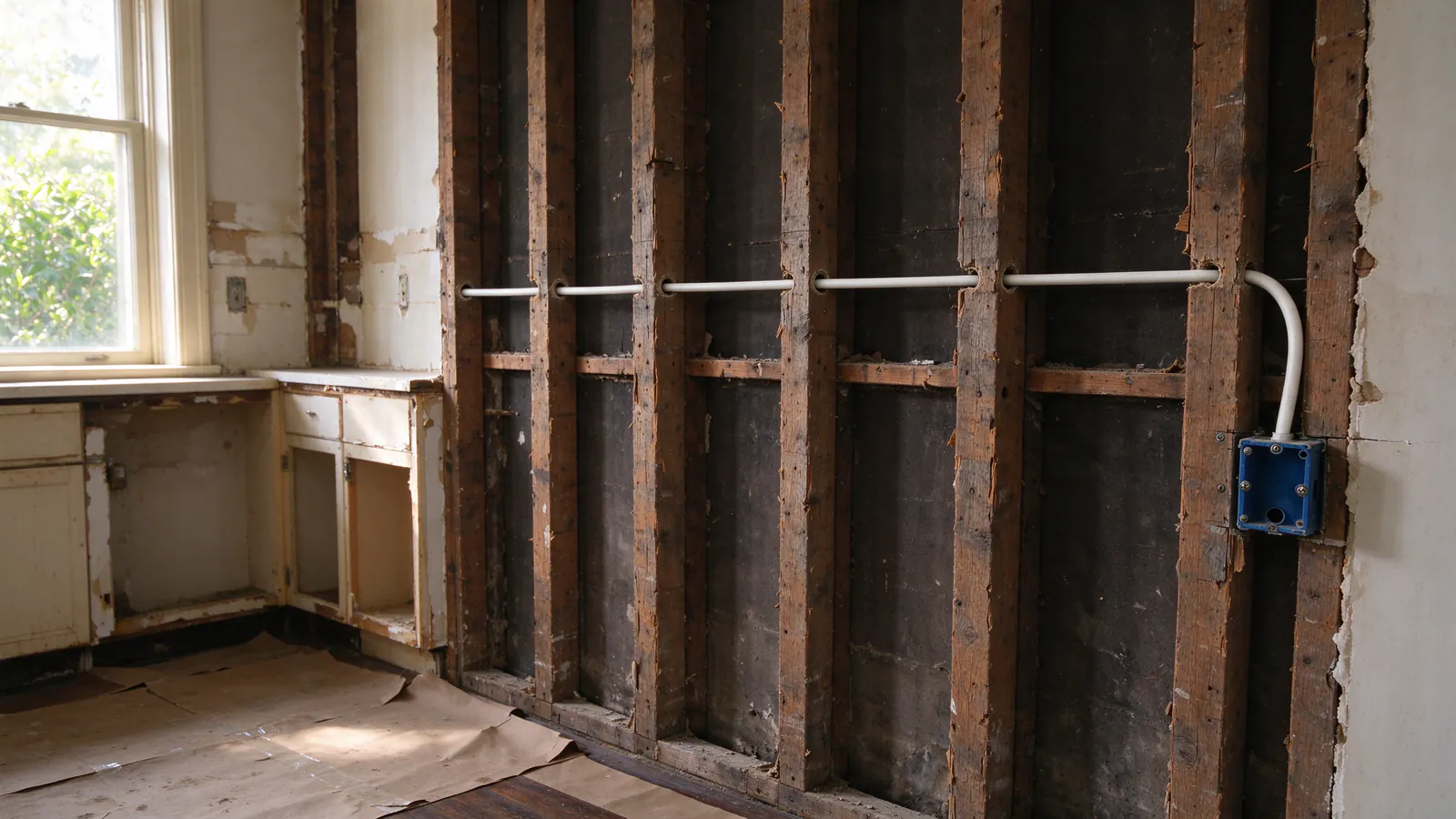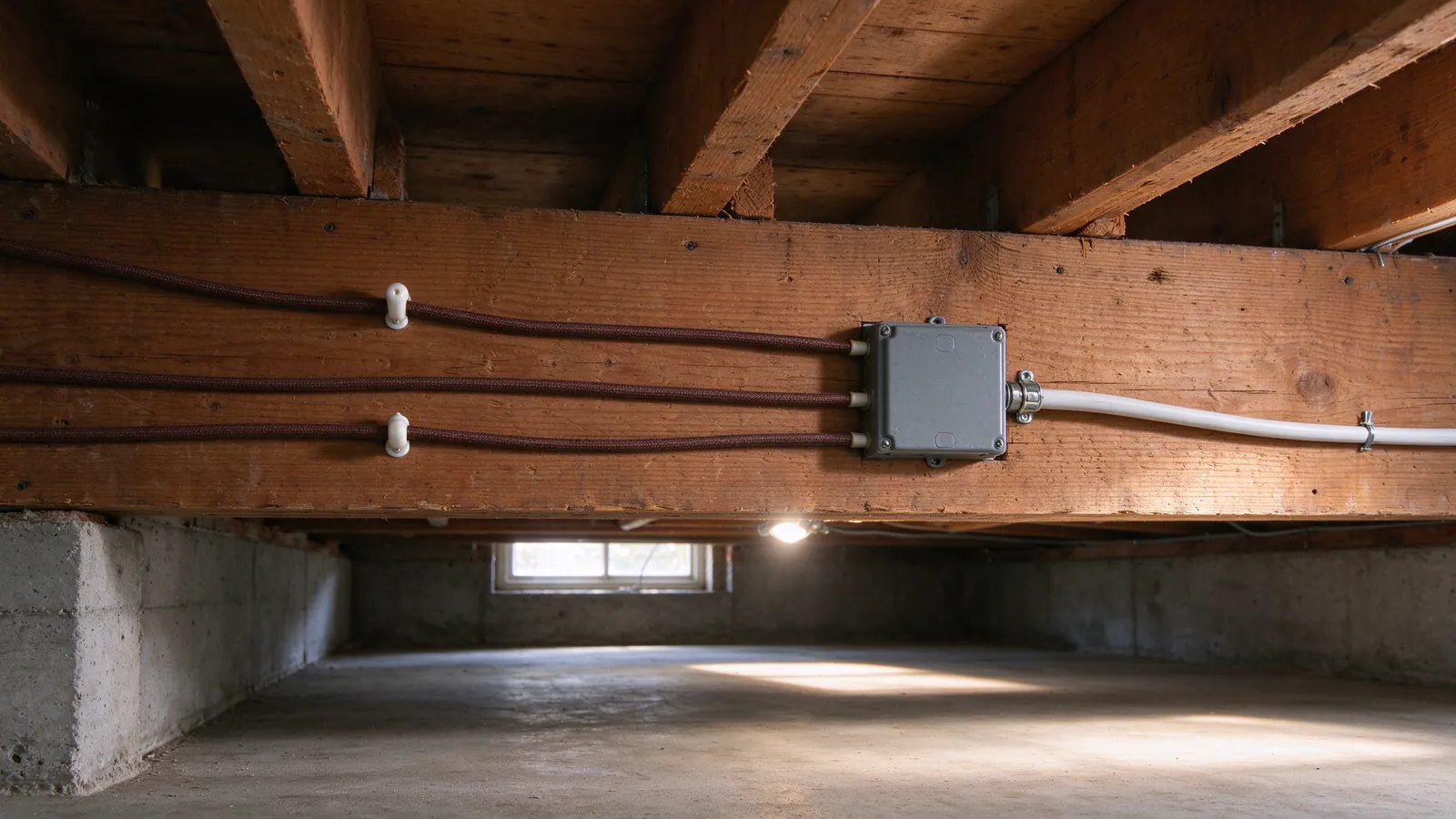
It means part of the house was rewired with modern nonmetallic cable, the white or yellow jacketed cable people call Romex after one brand name, while some original knob and tube circuits stayed in service and were connected to it. The mix itself is normal. The joints where the two systems meet, often hidden in walls and ceilings, are what deserve attention.
Fog City SF Knob and Tube manages knob and tube projects across San Francisco and the East Bay, and licensed and insured California C-10 electrical contractors carry out the electrical work. A mixed house is the situation a remodel knob and tube replacement usually starts from, and this guide explains why the junctions matter, what a shared neutral is, and how a scope settles what is left.
Why so many older houses have both
Few older houses still run on nothing but their original wiring. Over a century, owners remodel kitchens and bathrooms, finish basements, add a laundry, change a panel, or rewire the rooms that were easiest to reach. Each of those projects ran new cable where the walls were open and often connected it to whatever circuit was already there. The rest of the knob and tube stayed live because nobody needed to touch it.
San Francisco’s permit records show the pattern. Of the 2,023 electrical permits filed since 2016 whose descriptions name knob and tube, 156 also mention a remodel or renovation. One reads “remove remaining knob and tube in rooms referenced”, another “rewire remaining knob and tube wiring in home.” Both describe houses where earlier work had already replaced part of the system and left the rest.
Where the two systems usually meet
A homeowner can rarely see the junctions, which is the point. They tend to sit in a few predictable places:
- Ceiling fixtures. A replaced light or fan often has new cable from the switch joined to the old run that feeds the fixture from above.
- Remodeled rooms. A new kitchen or bath circuit may have been fed from an old splice in the ceiling or wall next door rather than from the panel.
- Attics and basements. Where new cable runs along joists, look for the point where it stops and an old conductor on knobs continues. The connection may be in a box, or it may be a splice hanging in the open framing.
- Behind outlets. A three-prong outlet on new cable can be fed from an old two-wire circuit one outlet upstream, so it looks modern and has no ground.
- At the panel. A new panel or breaker can feed an original knob and tube circuit directly, which the panel upgrade vs rewiring guide explains.
None of these can be confirmed by eye from a room. The identification guide covers what an owner can safely look for, and the active vs abandoned guide explains why “present” and “live” are different findings.
Splices and junction boxes
Original knob and tube splices were twisted, soldered and taped in the open framing, which was the method of the day. Later connections between old and new wiring are where the trouble concentrates. A modern cable joined to rubber-insulated conductor has to be made without cracking insulation that has hardened for decades, and the joint belongs inside a box that stays reachable. Splices buried in a wall or ceiling with no box, wrapped in tape, or made with mismatched wire sizes can loosen, heat and arc, and they are out of sight while they do it.
San Francisco’s electrical code is clear that concealed work has to be inspected before it is covered, and DBI can order uninspected work exposed at the owner’s expense. That is one reason a buried junction from an old remodel is treated as a finding to fix rather than something to leave behind.
Shared neutrals: the hidden part of a mixed house
Every circuit needs a path out on the hot conductor and back on the neutral. In original knob and tube, the hot and neutral of a circuit ran as separate wires on separate knobs, sometimes along different routes, and over the years some neutrals ended up carrying return current for more than one hot. When a later remodel connected new cable to that system, the new circuit’s neutral could be tied into an old neutral that also serves another circuit.
That matters for three reasons:
- Off is not always dead. Turning off one breaker may leave current flowing on a shared neutral from another circuit, so a “dead” circuit can still be energized.
- Protection can misbehave. Ground-fault and many arc-fault devices compare current leaving on the hot with current returning on the neutral. If part of the return comes back on a different circuit’s neutral, the device can trip for no visible reason or be impossible to apply correctly.
- Overload is unprotected. A breaker watches its own hot conductor. A neutral carrying return current from two circuits can be loaded beyond what either breaker sees.
None of that can be worked out from the outlets. It shows up when each circuit is tested and traced, which is why the AFCI and GFCI guide treats protection on mixed circuits as a decision for after the testing.
Can knob and tube be connected to Romex?
Physically it has been done in thousands of houses, but tying new cable onto an old run extends the old circuit, and that changes the question from wiring to permission. San Francisco requires a DBI electrical permit before wiring is altered, extended or added; only like-for-like device replacement with no change in existing wiring is exempt. The City of Alameda’s Building Official states that knob and tube “cannot be extended,” while existing wiring may be repaired or re-energized. Some electricians will not extend it anywhere, because the old insulation tends to crack as soon as it is moved.
The durable fix is to replace the old part of the circuit back to the panel, so the new cable never depends on a century-old conductor. This guide gives no steps for making that connection yourself, for the reasons above: brittle insulation, circuits that stay live with the breaker off, and joints that need an inspection before they are covered. The repair guide covers where a limited repair is still reasonable.
What a mixed house means for insurance and sale
Insurers tend to ask a blunt question: is any knob and tube still active? A mixed house usually has to answer yes, even when most of it is modern. Thirty San Francisco permits that name knob and tube, filed since 2016, cite an insurer in their descriptions, and one reads “insurance company advised owner to make it redundant and disconnect.” No carrier’s underwriting rule is public, so no one can promise how an insurer will treat the house after the work. What helps is a document that says exactly which circuits remain, which were replaced and which were disconnected; an electrical inspection for insurance produces it, and the California insurance guide covers the options.
At sale, California Civil Code 1102.6i, on or after January 1, 2026, requires sellers or their agents to tell buyers it may be advisable to have the electrical system inspected. A mixed system is exactly what that inspection tends to find.
Not sure where your old and new wiring meet?
Testing each circuit at the walk-through finds the points where modern cable hands off to knob and tube.
How a scope settles a mixed system
Every circuit is tested at the walk-through, and the result is a written circuit record and a labeled panel directory: which circuits are fully modern, which are fully original, and which change from one to the other partway along. That map decides the scope.
| What testing finds | Usual scope |
|---|---|
| A few circuits still original, the rest modern | Partial replacement of the remaining circuits back to the panel |
| Many circuits that change era partway, with buried junctions | Whole-house rewiring, so no joint between eras is left |
| Old runs no longer feeding anything | Disconnect at both ends and remove where reachable, or identify and terminate |
| One damaged junction on an otherwise sound circuit | A permitted repair, if the rest of the circuit justifies keeping it |
New cable is routed from attic, basement and garage paths first, with small openings where a run cannot be fished, and every opening and who closes it is listed in the written scope. Old runs are disconnected at both ends and removed where they can be reached; San Francisco’s code requires unused conductors to be removed or identified and terminated in an approved manner. A knob and tube inspection on its own covers the testing half when no work is planned yet.
Signs to act on now
- A warm outlet, switch or fixture, or a burning smell, on any circuit
- New GFCI or AFCI protection that trips without an obvious cause
- A circuit that still has power somewhere after its breaker is turned off
- Splices hanging in open framing or wrapped in tape where new and old cable meet
Stop using that circuit and have it checked before relying on it again. If you want to sort what you already know first, the risk assessment tool walks through it.
Planning around a mixed house
A mixed system is not a verdict on the house. Many have only a handful of original circuits left, and those can be replaced without touching the rooms an earlier remodel already finished. What matters is knowing where every circuit changes era, so nothing old stays connected behind a modern-looking outlet. If you know roughly when earlier work was done, that is a useful start: call (628) 296-7628 or request an estimate with the age of the house and the remodels you know about.